
The challenge
Most projects generate value only once, and the knowledge created during delivery often remains underutilized.
Event Owners
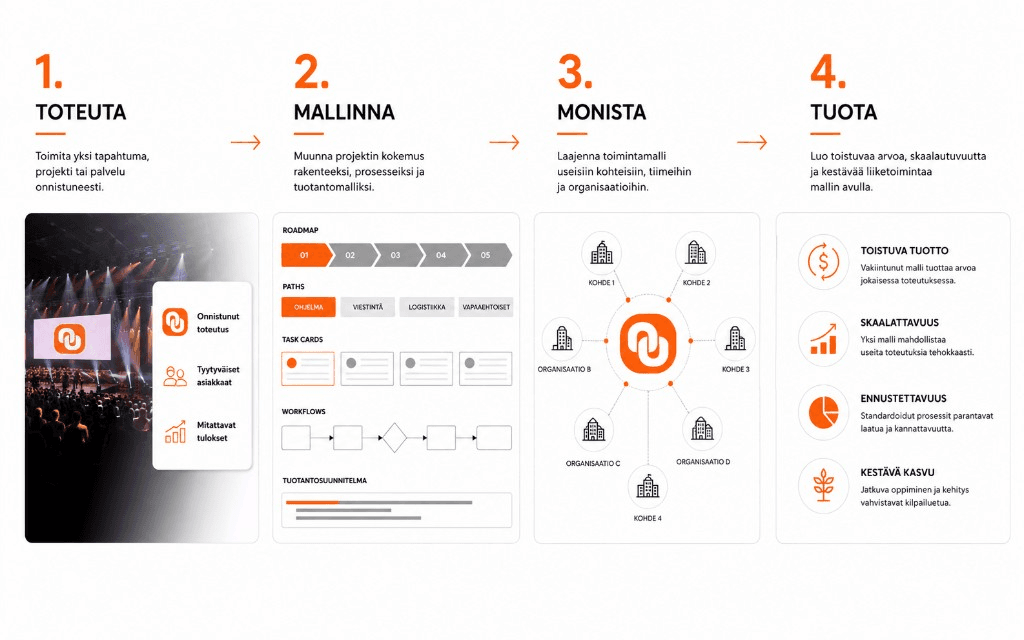
What if your event concept could create value far beyond a single project? Most projects generate results only once. After the project ends, much of the knowledge, experience and operational know-how created during the process remains underutilized. With Sapluna, a successful project can be transformed into an operational model that improves future deliveries and, ultimately, enables concept licensing to other organizers. This allows a single project to evolve into a long-term and scalable source of revenue.
Event Owners
Event owners · continuous revenue stream
Result
The first benefit is better project performance. The second is increased efficiency and profitability in future deliveries. The third and greatest opportunity emerges when a successful project evolves into a licensable concept that continues generating value long after the original implementation. The greatest value of Sapluna is not that it allows you to license your concept. The greatest value is that if your concept ever becomes a hit, the scalable operational model is already in place.
The Challenge
Every project is an investment.
During a project, organizations create knowledge, processes, plans, networks, operational experience and proven best practices. Too often, however, the return on that investment is limited to a single delivery, even though the assets created during the project could continue generating value for years.
Many event, programme and service owners ask themselves:
The first priority is always to create a successful project. However, it is equally important to consider how the knowledge and operational practices generated during that project can be preserved, improved and potentially commercialized in the future.
The Sapluna Concept Development Path
In Sapluna, the operational model is not a separate document created after the project.
Instead, it is built through the project framework, roadmap, paths, task cards, production plans and reporting structures used throughout the project lifecycle.
When the project is completed, the operational model already exists and is ready for future use.
The first benefit is gained internally through more efficient and predictable project execution. The second benefit emerges when the concept becomes valuable enough for others to adopt.
Project Delivery
Operational Model Development
Concept Replication or Licensing
Example Workflow
Everything starts with a single project.
The concept owner delivers an event, programme or service using their own organization. Objectives, responsibilities, schedules, processes and production plans are defined and tested in practice.
At this stage, licensing is not the goal. The goal is to create a successful concept and a successful project.
Value is always created through real-world execution.
Throughout the project, Sapluna brings together:
As a result, the operational model develops naturally alongside daily project work.
For most organizations, this is where the greatest benefit is realized.
Once a project has been modelled, future deliveries can start faster, onboarding becomes easier, operational consistency improves and profitability can be enhanced from one delivery to the next.
Even if the concept is never licensed to external organizations, modelling generates significant long-term value.
If the concept gains recognition and market demand, organizations may become interested in using it themselves.
Successful concepts are rarely created with licensing as the primary goal. They are created to solve real needs and deliver successful projects.
However, when a concept becomes a hit, replication becomes significantly easier if the operating model has already been built.
With Sapluna, that readiness is created as part of normal project work.
Organizations acquiring a license gain access to:
This substantially lowers the threshold for implementation and increases the likelihood of success.
At this stage, the project becomes more than a single event.
It becomes a business asset.
The same concept can be delivered simultaneously in multiple locations or repeatedly over many years.
The lifecycle of the original investment is extended, creating an entirely new revenue model around the concept.
Results
The challenge
Most projects generate value only once, and the knowledge created during delivery often remains underutilized.
How Sapluna helped
Sapluna transforms project knowledge into an operational model built around project frameworks, roadmaps, paths, task cards and production plans, supporting both continuous improvement and future licensing opportunities.
The outcome
The first benefit is better project performance. The second is increased efficiency and profitability in future deliveries. The third and greatest opportunity emerges when a successful project evolves into a licensable concept that continues generating value long after the original implementation. The greatest value of Sapluna is not that it allows you to license your concept. The greatest value is that if your concept ever becomes a hit, the scalable operational model is already in place.
More in this category