The challenge
Venue operations had become dependent on individual employees. Although common tools existed, they were used differently across the organization, resulting in inconsistent customer experiences and fragmented knowledge.
Event Venues
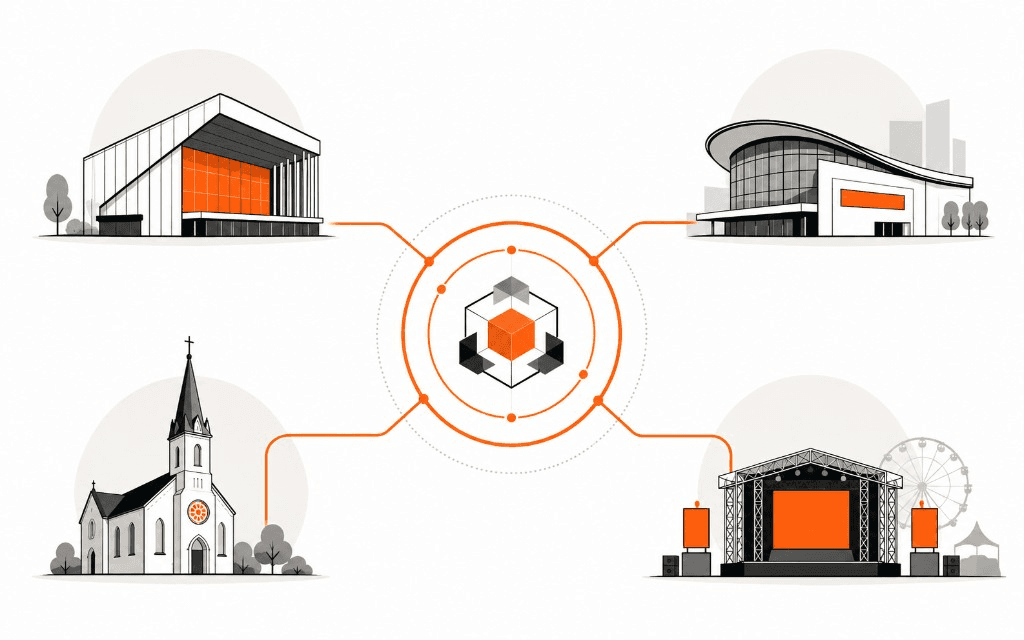
Successful event venues are not built around individual employees but around a shared operating model. Sapluna helps organizations create a unified operating model across all their venues. When service processes, responsibilities, information management and customer experience follow a common framework, organizers receive a consistent service experience regardless of venue or contact person. At the same time, organizational knowledge becomes a shared operating model instead of being dependent on individual employees.
Event Venues
Event venues · shared operating model
Result
The organization gained a shared operating model that can be deployed across all venues. Knowledge became organizational rather than personal, service quality improved and customers received a consistent experience regardless of venue or contact person.
The Challenge
Even when an organization uses shared systems, tools and guidelines, working practices often evolve into individual ways of operating.
The result is an operation that depends heavily on individuals. When knowledge and processes reside in people instead of a shared operating model, workload increases, reaction time slows and service quality suffers.
The Sapluna Venue Service Path
Source
The process starts at the organizational level where operating models, project templates, resources and services are managed. Projects can be initiated through:
Organizations can select a predefined project template containing workflows, tasks, documents, roles and communication structures.
Processing
Preparations follow a shared operating model. Contracts, approvals, reservations and other processes can remain in existing organizational systems. Information and documents are connected into one project environment through integrations or manual processes.
Usage
Venue staff, organizers, partners and stakeholders use the same information throughout planning, delivery and post-production. Information remains available for future projects and continuous improvement.
Example Workflow
An organizer receives guidance about venue services and practices. Information can be collected through online forms and stored directly in the project.
Schedules, contacts, venue requirements and service needs are gathered into one environment.
Contracts may be created in existing organizational systems. Approved documents and records are linked to the project through integrations or manual uploads.
Facilities, resources and responsibilities are confirmed according to the shared operating model.
Organizers can be provided with Guest access to view tasks, documents, communications and project information. Additional permissions can be granted when required.
Facilities, staff, equipment, partners and additional services become part of the project. Organizers can purchase venue services and approved partner services through Sapluna Shop.
Communications, decisions, comments and instructions are stored as project information instead of remaining in email threads.
Event summaries, schedules and operational documents can be generated from existing project information.
Sapluna tracks task completion, highlights delays and provides real-time readiness visibility.
AiLi answers questions, guides users through processes and helps prepare plans and documents.
Organizers can be required to acknowledge critical documents such as safety instructions. These records become part of the project history.
Public event information can be automatically published on venue websites.
Staff and organizers use Sapluna during the event. Critical operational tasks, safety briefings and venue handovers can be acknowledged and documented in real time.
Observations, incidents and deviations are recorded as part of the project history.
Feedback surveys, reporting, billing information and project documentation are collected and stored.
Project information is also transferred to organizational knowledge assets such as customer history and venue history.
Defined data can be transferred automatically to CRM, ERP, finance and reporting systems according to organizational rules.
Documentation, communications, analytics, acknowledgements and lessons learned become organizational knowledge that supports future projects.
Results
The challenge
Venue operations had become dependent on individual employees. Although common tools existed, they were used differently across the organization, resulting in inconsistent customer experiences and fragmented knowledge.
How Sapluna helped
Sapluna connected customer service, contracts, resources, communication, documentation and event operations into one shared service path.
The outcome
The organization gained a shared operating model that can be deployed across all venues. Knowledge became organizational rather than personal, service quality improved and customers received a consistent experience regardless of venue or contact person.
More in this category